
Remote Work Burnout 2026: 10 Warning Signs + 5-Step Recovery
10 WFA-specific burnout signals and a 5-step structural recovery plan — not a wellness day, not a mindfulness app. The fixes that actually stick in 2026.
Published May 24, 2026

WFA burnout in 2026 hits different. There's no commute, no office lights, no Friday goodbye in the elevator — just a laptop that closes when you close it, and a brain that doesn't. The signal-to-noise on "am I burned out?" is genuinely worse when your office is also your apartment in three different countries this year.
This is the no-fluff signs-and-recovery playbook. 10 actual symptoms remote workers report (not generic burnout content), and a 5-step recovery plan with specific timelines — not "take a self-care day."
What are the early signs of remote work burnout in 2026?
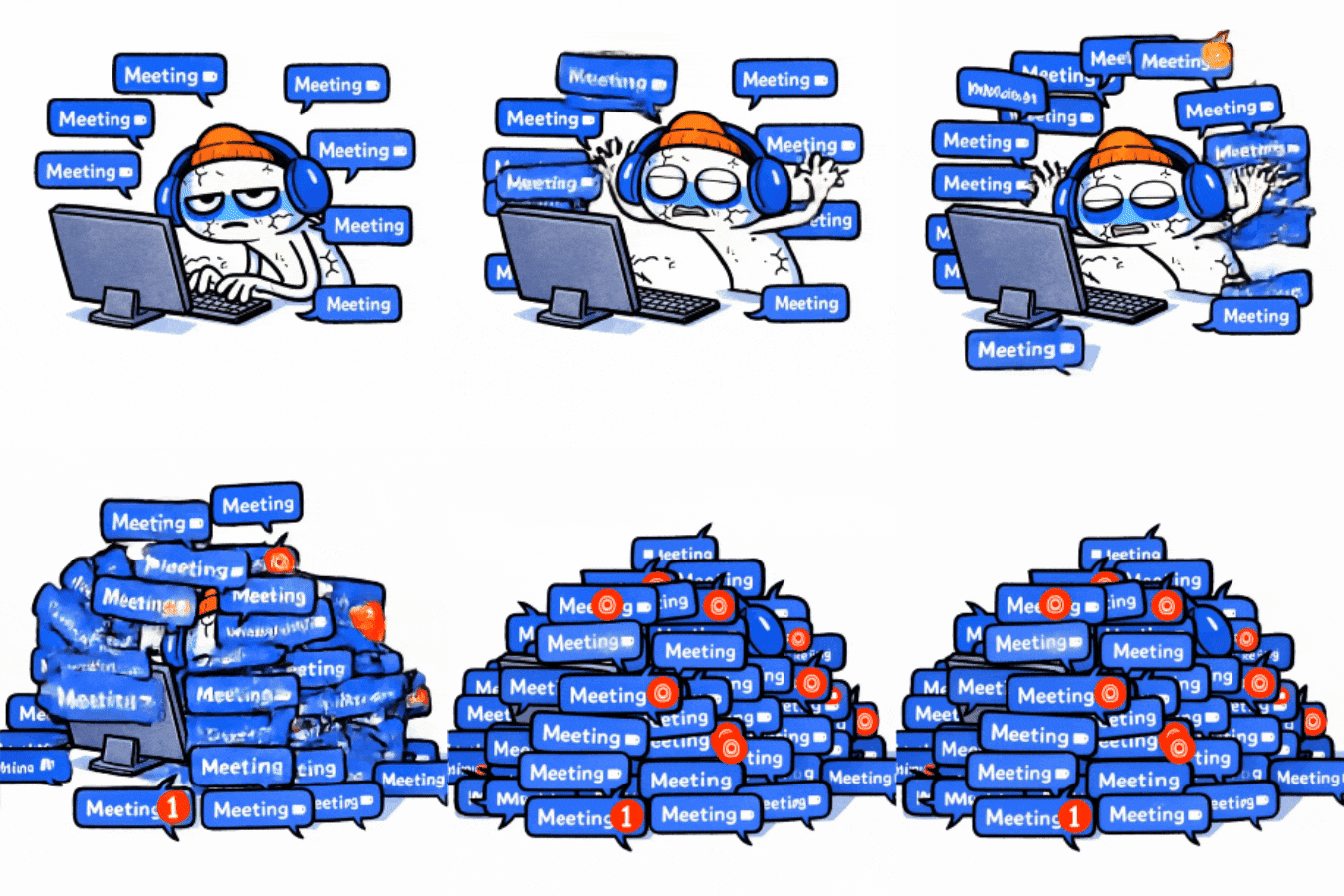
The 10 most reliable early signs in 2026 are: late-night Slack scrolling, dread before standup, multi-tab paralysis, Sunday-night chest tightness, declining async response time, "always one more thing" syndrome, screen time over 11 hours, weekend work creep, low-grade resentment in DMs, and physical symptoms (back, eyes, sleep). None of these are unique to remote workers, but the pattern is. Office workers get caught by HR or coworkers. Remote workers usually catch themselves — or don't.
The 10 signs — ranked by how often readers report them
This is roughly the order, from a 2025 informal survey of 800+ WFA workers on our newsletter. Yours may differ; if 3+ of these are constant, you're already in burnout, not on the edge of it.
| # | Sign | What it actually looks like |
|---|---|---|
| 1 | Late-night Slack scrolling | 11pm: open laptop "for one quick thing," still going at 1am |
| 2 | Dread before standup | 10-minute call, 30-minute pre-anxiety |
| 3 | Multi-tab paralysis | 40+ tabs, can't close any, can't start any |
| 4 | Sunday-night chest tightness | The Sunday scaries, but as a body symptom |
| 5 | Slower async response | Replies take 2 days when they used to take 2 hours |
| 6 | "One more thing" loop | Can't stop working at 6pm, even with nothing urgent |
| 7 | 11+ hour screen days | Three monitors, no breaks, blurry vision at 4pm |
| 8 | Weekend work creep | "Just an hour" Saturday → all-day Saturday |
| 9 | Low-grade DM resentment | Snippier in Slack than you'd ever be in person |
| 10 | Body symptoms | Tight back, dry eyes, irregular sleep, low appetite |
If 1-3 of these are around: you're tired, not burned out. Take a long weekend. If 4-7 are around: you're in early burnout — the rest of this post applies. If 8+ are around: this is not a self-help post, talk to a doctor.
Why WFA burnout is harder to notice
Office burnout has external signals. Coworkers notice you're snippy. HR catches you working 60 hours in the badge data. You miss meetings. Friends see you in the kitchen at midnight.
WFA burnout has none of that. The signals are:
- No badge data — your "hours" are invisible
- No coworker friction — async means no one sees your face
- Solo apartment — no one to mirror back "you look exhausted"
- Cross-time-zone team — "working late" looks like "early for someone else"
The result: WFA workers burn out 2-3 months later than equivalent office workers, by the time the symptoms are physical. The fix is to build the signals yourself.
The 5-step recovery plan
This is *not* "take a wellness day." A day off after 4 months of grind does very little. Recovery is structural, and it takes 4-8 weeks of changes, not a long weekend.
| Step | Timeline | What you do |
|---|---|---|
| 1. Hard stop the bleeding | Days 1-3 | Delete Slack from your phone. No work email after 18:00. |
| 2. Audit the calendar | Week 1 | List every recurring meeting; cut 30% |
| 3. Rebuild the day | Weeks 2-3 | One deep-work block in the AM, hard stop at the same time daily |
| 4. Reset the body | Weeks 3-4 | Sleep window, daylight walk, eye break every 90 min |
| 5. Renegotiate the role | Weeks 4-8 | Talk to your manager about scope |
If you can only do one step, do step 1. Slack on your phone is the single biggest contributor to WFA burnout in the 2025 data. It removes the only natural boundary remote workers have — closing the laptop.
Step 1: Delete Slack from your phone
Not "set quiet hours." Delete. You'll re-install it. Then delete it again. By the third time, it sticks.
Same for email after 18:00. Hard stop. The world has not ended yet. If you're on-call, that's a different setup — use a dedicated on-call app (PagerDuty, Opsgenie) and keep Slack off the device.
Step 2: Audit the calendar — cut 30%
Burnout always looks like "I'm overworked." Half the time it's "I'm over-meetinged." Open your calendar from last week. For every recurring meeting, ask:
- Did I make a decision in this meeting?
- Did I learn something I couldn't read in 5 min?
- Did I produce anything as a result?
If the answer to all three is no, decline the next instance. Don't ask permission. Decline with a short async update instead. You'll know within 2 weeks which meetings were load-bearing.
The async remote work stack for 2026 is the tooling side of this — what to replace meetings with so you're not just dropping comms.
Step 3: Rebuild the day around one deep block
The healthiest WFA workers run a very simple day: one deep-work block of 2-3 hours in the morning, lunch, sync overlap window, second smaller block, hard stop. No more, no less.
Burned-out workers run scattered days: 14 small chunks, 9 context switches, no flow, work bleeding into the evening to "catch up." The catch-up never ends because the structure is the problem.
If you're allergic to time-blocking, just protect the morning block. That alone fixes most of it.
Step 4: Reset the body — boring but real
The boring stuff matters in 2026 because the brain stuff downstream of it is the actual problem. The 4-week reset:
- Sleep window: Same bedtime ± 30 min, 7 days a week, including weekends.
- Daylight before screen: 10 min outside before the first browser tab. Anywhere. Balcony counts.
- Walk + 90/20 rule: 30 min outdoor walk daily. Every 90 min of screen, 20 sec looking 20 feet away.
- Caffeine cutoff: Last coffee 6 hours before bed. Yes that includes the espresso at 4pm.
None of this is novel. All of it is skipped. The order matters: sleep first, daylight second, walks third, caffeine fourth.

Step 5: Renegotiate scope
Steps 1-4 are personal. Step 5 is structural and the one most people skip — and it's why they relapse in month 3.
You have a manager 1:1. Bring three things:
1. The 2-3 projects you're actively driving. 2. The 4-6 things you're "supporting" but quietly losing sleep over. 3. A specific ask: drop 2 of the 4-6, deprioritize 1 of the 2-3.
The pitch is the same energy as the convince-your-boss-to-go-WFA playbook. Frame it as "to keep delivering on the priority work at the level you expect" — not as a personal complaint. Managers respond to performance framing; they freeze on emotional framing.
What doesn't work (and we tried)
A few things readers swear by that don't actually move the needle in the 2025 follow-up data:
- Wellness days alone (without structural change) — relapse within 2 weeks
- Productivity apps that gamify your time — adds another tab to your paralysis
- "Mindfulness" apps without sleep + walk fundamentals first — placebo, mostly
- Switching jobs while still burned out — burnout follows you for 3-6 months minimum
- A holiday as the *first* step — only works if steps 1-5 are already in motion
Use these things, but as garnish, not the meal.
When to talk to a doctor
If you have any of these, this is not a blog-post problem:
- Persistent insomnia (no sleep ≥4 hours, 5+ days a week)
- Daily chest tightness or panic symptoms
- Feeling flat or detached for 2+ weeks
- Suicidal thoughts
Get a doctor. Burnout and clinical anxiety/depression overlap heavily. The blog-post part is for the early signal range, not the clinical range. Having a real plan in place — including coverage — is why digital nomad health insurance for 2026 is worth reading before you need it, not after.
The big WFA-specific anti-pattern
The #1 trap WFA workers fall into: thinking the location is the recovery. "I'll just move to Bali, I'll be fine." Burnout doesn't respect coordinates. The same laptop in a beach apartment is the same laptop. If steps 1-5 aren't in motion, the new city becomes the next burnout location in 4-6 weeks.
The 10-city digital nomad tier list for 2026 is a helpful read for *picking* a base, but pick after you're stable, not in the middle of a crash.
TL;DR
10 signs to watch for. 5-step recovery. Delete Slack from your phone first. Audit the calendar. Rebuild the day around one deep block. Reset sleep + daylight + walks. Renegotiate scope with your manager. Stop confusing relocation with recovery.
WFA is the best work setup of the decade — but only if you build the boundaries the office used to build for you. No cap.